Private Equity Value Creation: Buyouts, M&A & Strategy Evolution
Evolution of Value Creation Strategies in Private Equity Buyouts
Addressing the Evolution of Value Creation in Private Equity and M&A
It's important to delve into the evolving landscape of value creation in private equity, a topic I've previously talked about in sessions available within the M&A hub. For this discussion, let's focus on Private Equity, as it spearheads some of the largest buyouts and M&A transactions globally. Their approach to executing private equity buyout investments varies, with returns primarily driven by revenue growth, margin expansion, changes in valuations, and financial structuring.
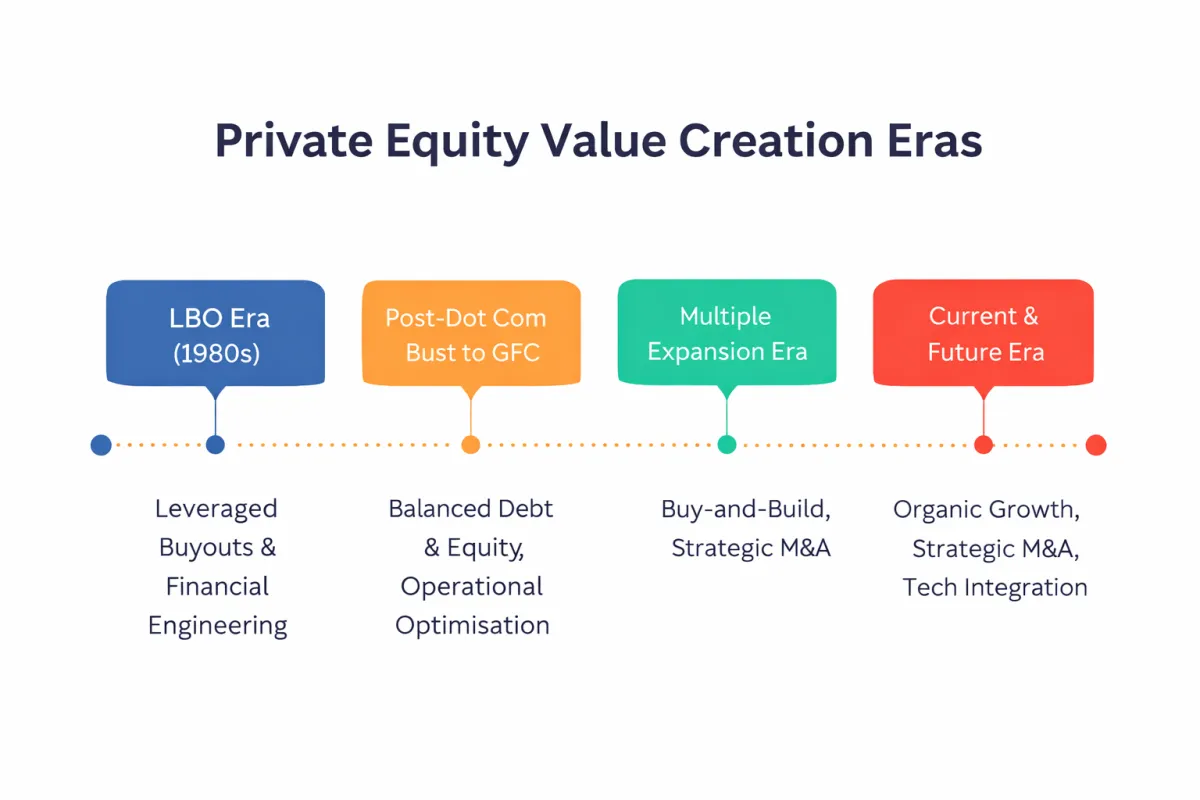
Over the past four decades, the private equity buyout market has changed many times. The playbook for value creation in buyouts has seen multiple transformations, with a shift away from heavy reliance on leverage and financial engineering towards a more nuanced focus on multiple expansion, operational excellence, and sustainable value creation, particularly emphasising human capital.
1st Era: The LBO Era (1980s) and Financial Engineering in Buyouts
The 1980s marked the era of Leveraged Buyouts (LBOs), characterised by the emergence of leveraged loans and favourable tax and regulatory changes. Leverage played a massive role in driving returns during this period, often at the expense of operational efficiency. However, aggressive cost-cutting measures sometimes hindered portfolio companies' ability to operate effectively, highlighting the importance of robust deal structures, disciplined capital stack design, and stress testing within M&A transactions.
2nd Era: Post Dot-Com Bust to GFC – Operational Value Creation in Private Equity
Following the dot-com bust and leading up to the Global Financial Crisis (GFC), private equity firms shifted towards a more balanced approach between debt and equity. Greater emphasis was placed on generating value at the enterprise level, with a focus on revenue growth, margin expansion, and operational optimisation. Revenue growth emerged as a significant driver of private equity value creation; however, it is important to remember that not all revenue is good revenue.

3rd Era: Multiple Expansion, Buy-and-Build, and Strategic M&A
In the past two decades, multiple expansion has played a pivotal role in private equity buyout value creation, particularly in the post-GFC environment. This expansion has been driven by both market dynamics and manager-specific M&A strategies, such as buy-and-build approaches. Additionally, strategic initiatives such as consolidating smaller companies within the same sector through strategic M&A have contributed to enhanced cost efficiency, stronger market positioning, and improved valuation outcomes.
Current Era and Future Outlook for Private Equity Value Creation
Looking ahead, the next decade is unlikely to mirror the last. A more proactive and deliberate approach to value creation in private equity will be required. Anticipating challenges such as slower economic growth, demographic shifts, and potential inflation, there is an increasing need to focus on organic revenue growth, operational excellence, strategic mergers and acquisitions, human capital development, and technology integration.
A disciplined combination of financial structuring, operational improvement, and transaction-led growth through M&A may ultimately define the next era of private equity buyout strategy and value creation.


